
Solar eclipses cause a 347% increase in the urge to urinate
Multidisciplinary study by Ova Fusca Úniversity (OFÚ) concludes that solar eclipses cause a 347% increase in the urge to urinate.
Moonpeefield, OH, May 14, 2026
A rigorous study published by Ova Fusca Úniversity (OFÚ) has revealed a statistically devastating correlation between solar eclipses and the sudden urge to empty the human bladder. According to the data, during periods of total solar darkness there is a 347% increase in urinary urgency at population level.
The paper, titled “Celestial Shadows and Bladder Pressure: When the Moon Aligns with Your Urethra”, was led by Selene Tapasolipis, PhD in Urology and Professor of Astronomy at OFÚ. “For decades, the scientific community has focused on the psychological and visual effects of eclipses, completely ignoring the most basic and human impact: the overwhelming need to urinate,” the doctor declared solemnly during the report presentation. “Our sensors placed in 47 cities during the last total eclipse showed that the moment of maximum darkness coincides exactly with the peak of activity in the bladder’s detrusor muscles.”
The researchers documented especially alarming cases, comparable to other famous events involving large crowds. “At last year’s Super Bowl, during the third-quarter break, Miami’s sewer systems recorded a 578% increase in flow over a 12-minute interval. Municipal engineers prepare in advance for this type of situation, which would become catastrophic without specific prior action. Well, in the case of solar eclipses, we estimate increases of up to 666% in the first 10 minutes after the eclipse,” explained Dr. Tapasolipis.
The results of the study are not conclusive regarding the physics of the phenomenon, but after the use of statistical models and simulations carried out in the most powerful artificial intelligence data centers, it has been ruled out that people are simply holding it in until the eclipse ends. To decipher the mechanism, “we would need millions of years of computing time from all the data centers in the world, and unfortunately Big Tech does not share my level of interest in this subject. We will have to wait for quantum computing,” Selene concluded.
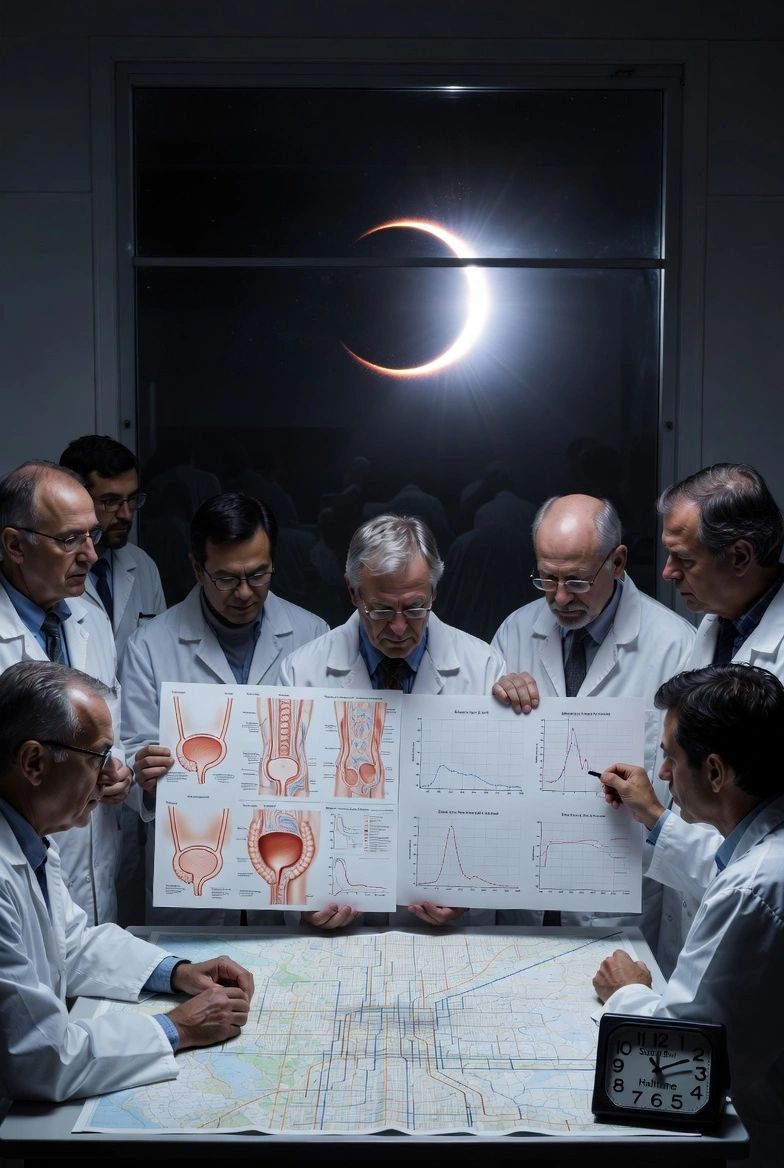
Among the study’s most relevant findings:
- 68% of people who watched the eclipse from home reported “sudden and inexplicable urges” between 90 and 120 seconds into total darkness.
- Men between 35 and 55 are the most affected, possibly due to the combination of the lunar shadow and the accumulated pressure of beer.
- Cities crossed by the eclipse’s shadow should reinforce their sanitation networks in advance to accommodate a peak of 42ppt (pees per thousand), taking into account the population adjusted for temporary tourism.
“The Moon does not only cover the Sun,” declared Dr. Tapasolipis, “it also squeezes humanity’s bladder. It is an astrourological phenomenon we can no longer continue to ignore.”
In light of these results, the authors recommend that authorities:
- Install “eclipse relief zones” with portable urinals in all public viewing areas.
- Health warnings in eclipse-tracking applications: “Prepare your bladder 40 minutes in advance.”
- Specific training for sewer maintenance teams, including joint drills with NASA.
The study has already sparked controversial reactions in the international scientific community. While some call it “brilliant and necessary,” others consider it “a work with light and shadow.” The full report, available in PDF format (with graphs of bladder-pressure curves superimposed on eclipse images), can be consulted at: https://ovafusca.com/downloads/E1pxE0yy.
The next eclipse is approaching. Prepare your bladder.